
From March 3-4, the Angelman Syndrome Foundation (ASF) and Foundation for Angelman Syndrome Therapeutics (FAST) held their third annual Angelman Syndrome Congressional Advocacy Day (ASCAD).
In convening people with disabilities, family members, caregivers, and policy experts, ASF & FAST demonstrate a uniquely intersectional approach to advancing a more interdependent future.
AS advocacy — and, for that matter, the advocacy of ASF and FAST — demonstrates how the pursuit of greater independent-living capacity can still be logically and strategically consistent with the pursuit of a reality of interdependence.
What’s the Story?
Last month, our co-founder Adam Beddawi participated in the 2026 Angelman Syndrome Congressional Advocacy Day. The event, co-hosted by the Angelman Syndrome Foundation (ASF) and the Foundation for Angelman Syndrome Therapeutics (FAST), brought together Angelman Syndrome (AS) families, researchers, and community members for two days of education, community-building, and direct advocacy.
Adam has a sibling with Angelman Syndrome (AS). Their relationship which informs his fierce advocacy for disability justice. As such, he has a real and clear stake in AS advocacy.
AS advocacy is also of interest to the team at The Interdependent Futures Lab (IFL) because it bridges two important and distinct, though often overlapping, constituencies within the broader disabled community: those who do rely upon the care of others and those who do not. By cohering these two disparate groups in their initiatives, AS advocacy aligns with our stated objective to “contribute to making the world work at least for those with the greatest access and support needs.”
AS advocacy is uniquely positioned as a unifying force due in large part to the specific symptoms and characteristics of AS.
What is Angelman Syndrome?
AS is a rare congenital neurogenetic disorder stemming from a lack of functional UBE3A protein in the brain, leading to a range of neurological symptoms.
People with AS — whose loved ones often call “Angels” — share a universally happy and excitable demeanor. They illuminate every room they are in with their smiles, laughter, and sheer force of will. These behavioral characteristics are also associated with other, more clinically significant characteristics, such as delays in early child development that become noticeable between the age of 6–12 months. Nearly all individuals with AS are non-verbal and experience motor impairments, seizures, and balance and coordination disorders. Due to their communication challenges, people with AS often exhibit anxiety and challenging behavior, which can mystify even the most experienced caregivers and skilled nurses.
The medical and practical complexity of AS symptoms impose significant challenges on people with AS and their caregivers. Relatedly, people with AS often develop an inseparable bond with their caregivers, with whom they develop a relationship necessarily predicated on trust and vulnerability. Through their repeated exposure to one another’s unique idiosyncrasies and attempts at effective communication, many develop what Mia Mingus once called access intimacy — “that elusive, hard to describe feeling when someone else ‘gets’ your access needs.”
While people with AS enjoy a normal life expectancy, they may experience premature death in the event they do not receive adequate care or support throughout the entire course of their life. As a result, the responsibility to provide specialized care for people with AS is often assumed by family members who do not yet require their own caregivers.
People with AS do not have the capacity for independent-living. However, small increases to their capacity to live independently may yield significant improvements to the quality of life and well-being of people with AS and their caregivers.
For what are ASF and FAST advocating?
The ASF/FAST joint initiative is relatively new; they held their Inaugural Angelman Syndrome Congressional Advocacy Day in March of 2024. In just a short time, they have made meaningful strides in their advocacy.
In 2024, ASF/FAST and 65 community members pushed Congress to require the FDA to use more sensitive and meaningful data when evaluating AS therapies. By 2026, ASF/FAST had gone further — partnering with the FDA to produce that data themselves, including a survey of 342 AS caregivers and an EL‑PFDD meeting with AS families. They captured the community’s priorities in the “Voice of the Patient” report, submitted in late 2025. That same year, ASF/FAST and more than 150 community members urged Congress to direct the FDA to use this community‑generated evidence to guide regulatory decisions and future AS therapy development.
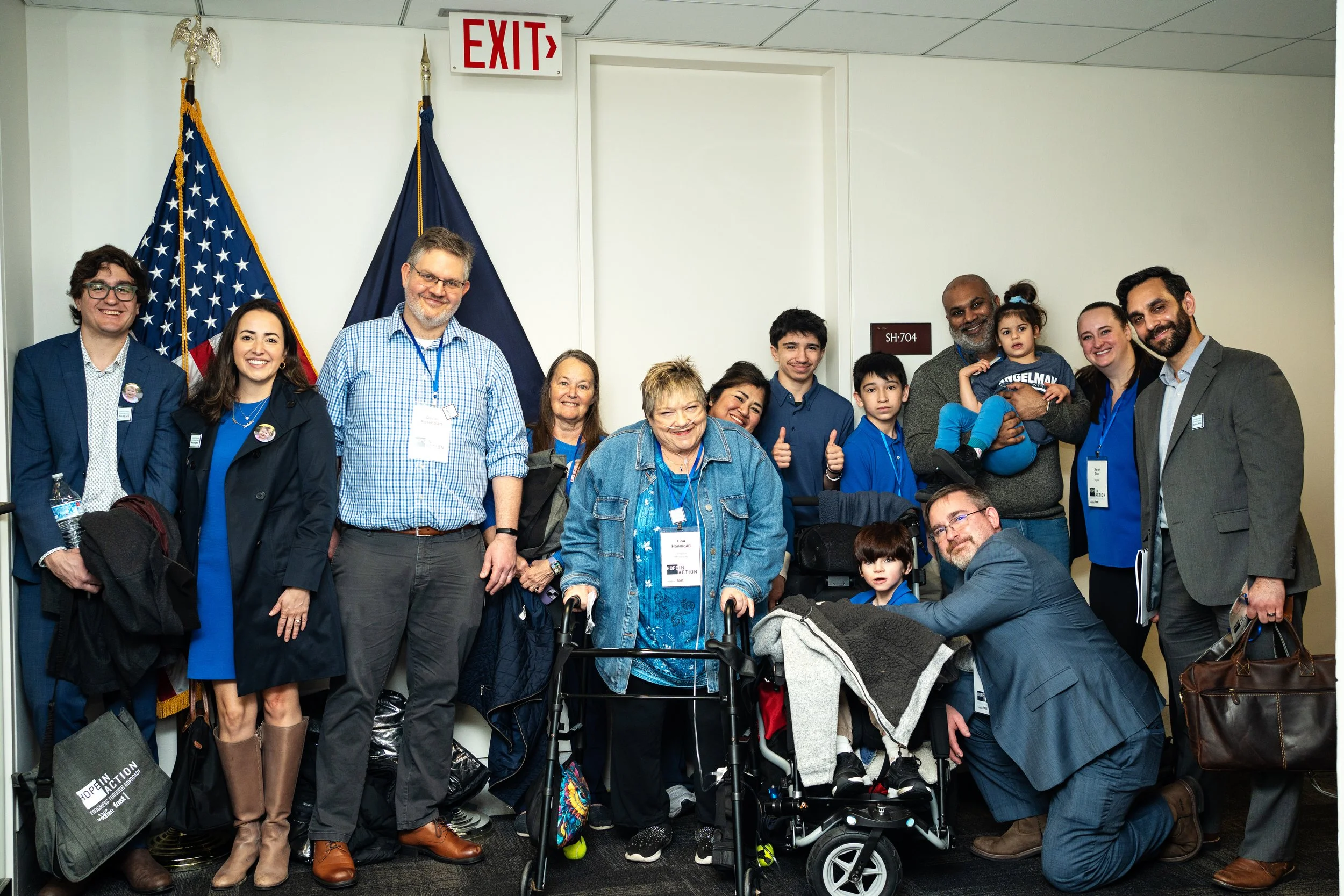
Angelman Advocates pose for a photo outside of the office of Senator Mark Warner, after a meeting to discuss their advocacy priorities.
Their progress over such a short period is both remarkable and a testament to their persistence and strategic clarity.
What’s the bigger picture?
In our blog on interdependence, we noted that all disabled individuals are marginalized under the prevailing ‘ideology of independence,’ which casts independent-living as a ‘proper goal’ of the nation with respect to the disabled population.
Under an ideology of independence, human value is conflated with human capital, the latter being a measure of skills and capacities that are productive in a labor market. This conflation is consistent with the functionalist perspective on disability, according to which disabilities are understood as an aberration within society; the cause of societal disequilibrium. In capitalistic societies, the functionalist perspective has given rise to the view that disabilities are to be managed in the ultimate pursuit of maximizing or optimizing overall productive capacity. The medical model, which understands disabilities solely as impairments which must be remedied through medical intervention or rehabilitation, represents one form of such ‘management.’
Rather than continue to live under an ‘ideology of independence’, we advocate for a collective pursuit of the ‘ideal of interdependence’. If realized, it would affirm the ‘reality of dependency’ we believe is made evident by any honest assessment of human societies.
AS advocacy — and, for that matter, the advocacy of ASF and FAST — demonstrates how the pursuit of greater independent-living capacity can still be logically and strategically consistent with the pursuit of a reality of interdependence. While many disabled individuals have the capacity for independent-living, many others do not. There is significant overlap between these two groups, given that people’s functional capacities change as they themselves age or as the built environment is made more or less accommodating. These two groups must be united by their common cause if we are to collectively build a more interdependent future.
The advocacy that stems from the ASF/FAST initiative is informed by their view that the symptoms and challenges of AS are both treatable and worth treating. In equal measure, it is informed by their commitment to address the disabling social conditions that impact people with AS as well as their families and caregivers.
In their advocacy for people with AS and their caregivers, ASF and FAST are advancing a uniquely intersectional approach to building a more interdependent future.